
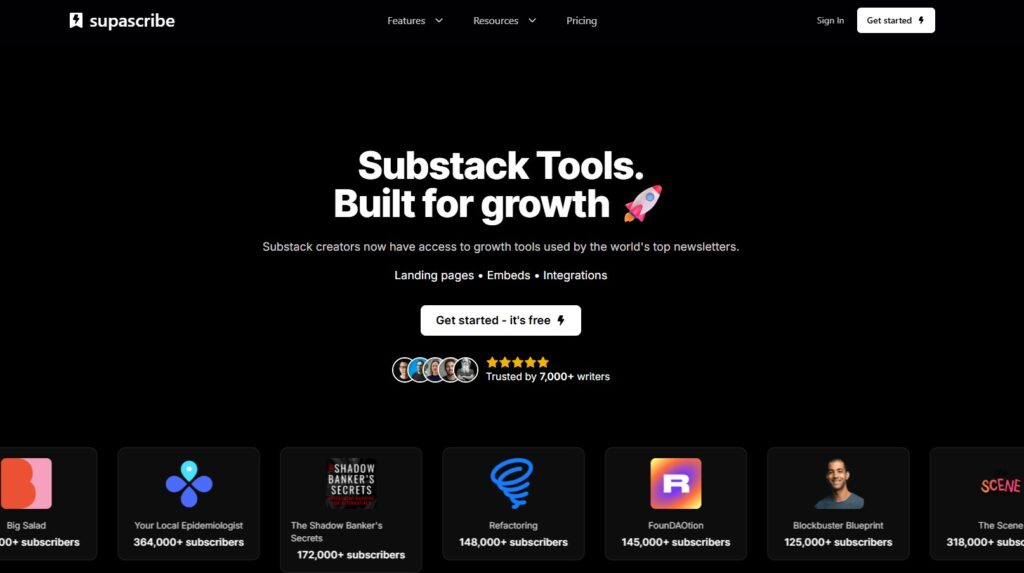
Starting a newsletter is easy with Substack. It’s more difficult to grow if it’s from your own website. Supascribe offers the missing pieces such as custom forms, feed widgets, popups and landing pages that automatically push every new subscriber into a writer’s Substack list.
According to its TrustMRR revenue profile, New Zealand founder Gideon Wislang has run the business alone since May 2025. It now has 161 active subscriptions, generating $2,445 in Monthly Recurring Revenue (MRR) and has generated $30,885 in all-time revenue. In October 2026, he listed it for sale at $75,000.
Supascribe At a Glance
| Metric | Verified Data |
|---|---|
| Company | Supascribe |
| Founder | Gideon Wislang, New Zealand |
| Founded | May 2025 |
| Team | 1 person, bootstrapped |
| MRR | $2,445 (161 active subscriptions) |
| Last 30 Days Revenue | $3,557 (up 32.5%) |
| All-Time Revenue | $30,885 |
| Profit Margin | 87% |
| Pricing | Free, then $9, $20, or $249 per month (billed yearly) |
| Status | Listed for sale at $75,000 (1.8x revenue multiple) |
Why Substack’s Native Embed Holds Writers Back?
Substack provides a free embed code for each writer. It works, but there are not many changes that can be made. Supascribe’s side-by-side comparison to Substack’s embed lists out the differences. The iframe prevents you from using custom styles; the form is fixed at 480×320 pixels, which is too large for most phone screens, and you can’t send new subscribers to a thank-you page after they sign up.
The bigger headache is tracking. The embed doesn’t report views or sign-ups on Substack and Google Analytics does not track views of the form within the iframe. For a writer who has a blog, podcast site or portfolio, it is not possible to determine which page is responsible for bringing in the visitors.
How Is Supascribe Adding Growth Tools On Top Of Substack?
Supascribe is a no-code solution for Substack writers.
The primary components are:
- A subscription form with custom colors, fonts, headline, and button text.
- A newsfeed embed that displays a writer’s recent posts and updates when they publish.
- Popups that appear when users are about to leave your site.
- Popups triggered by exit intent, scroll depth or time on page.
- A landing page builder for dedicated newsletter pages.
- View and conversion data, along with conversion rate, by placement.
Higher plans add integrations such as Zapier, a custom domain and API access. The tools can be used on WordPress, Squarespace, Wix, Carrd, and Framer and custom sites. According to the homepage, it has over 7,000 writers and is not affiliated with Substack Inc.
How A One-man Team Turned SubstackAPI Into Supascribe?
Gideon’s initial offering was an easier-to-use product known as SubstackAPI. In his first post on his own Substack, he describes himself as a full-stack developer and aspiring indie hacker who builds things with code as a creative outlet. His vision was to create no-code growth tools, experiment with the tools on his own newsletter and share what he learned.
Later, SubstackAPI was renamed to Supascribe. The founding date is listed as May 19, 2025 on TrustMRR and Gideon continues to operate it on Next.js, Firebase, Vercel and Stripe, primarily using SEO as a marketing channel. He says on the home page that Supascribe has helped writers gain over 1,000,000 new subscribers, which is a claim by the company itself.
Revenue hasn’t been increasing in a linear fashion. The monthly revenue for April 2026 was $977, with October 2026 seeing the highest monthly revenue at $3,113, the best month in its TrustMRR history.
Freemium Plans With Usage-Based Overages
The free plan includes two simple embeds, as well as the first 1,000 views and the first 100 new subscribers. After that, writers are required to switch to a paid plan:
| Plan | Price (Billed Yearly) | Main Limits |
|---|---|---|
| Starter | $9/month | 1 landing page, 3 embeds, 1,000 views, and 100 new subscribers per month |
| Growth | $20/month | 5 landing pages, 20 embeds, 50,000 views, and 1,000 new subscribers per month |
| Pro | $249/month | Unlimited pages and embeds, 1,000,000 views, and 20,000 new subscribers per month |
Yearly billing is 20% cheaper, and excess views and subscribers are charged at $2 per 10,000. As their users increase, Supascribe makes more money as the price goes up since it scales with the number of writers’ lists.
MRR rose only 1.6% over the last 30 days, while 30-day revenue jumped 32.5% to $3,557. A gap like that typically means that you’ll be paying for plans that are on an annual basis. That profit margin is 87% and very little of it goes into running costs.
What Is The Significance Of Substack’s 5 Million Paid Subscriptions?
Supascribe’s market is bound to one platform and that platform continues to expand. According to Axios, Substack raised $100 million in its Series C in July 2025, valued at more than $1.1 billion. By 2023, there had been 5 million paid subscribers, compared to 2 million in 2023, and over 50 of the creators were generating over $1 million in revenue per year.
Substack charges 10% of revenue from subscriptions, so it benefits when writers build their lists. All writers looking to get more sign-ups outside of the Substack app are potential Supascribe customers.
What can Platform-Dependent Tools tell about Risk and Value?
Supascribe was launched on a popular platform, which created instant demand. It just needed to fill in the gaps that were left by Substack’s embed.
The catch is that Substack controls the ground Supascribe stands on. If Substack provides better embeds or analytics, a big reason to pay is taken away.
That’s the risk that is reflected in the asking price. TrustMRR offers a 1.8x revenue multiple on the $75,000 listing, which isn’t that high given the 87% margin, but is closer to the revenue multiples small, single tools command. In our Selltora MRR growth case study, Enes Çamlıca’s Etsy seller tool was sold on TrustMRR for $15,000. Buyers are willing to pay for proven revenue and they won’t be interested in anything based on another company’s roadmap.
Why We Picked This Startup?
We chose Supascribe because it demonstrates what can be achieved by a single developer with a very specific problem to solve. No team, no outside funding and the product has verified revenue of $30,885.
It’s a good fact check, too. MRR is still less than $2,500, and the revenue fluctuates from one month to the next, with the entire business being reliant on Substack. Supascribe is a glimpse into the opportunity and the ceiling for founders considering developing platforms for creators.