
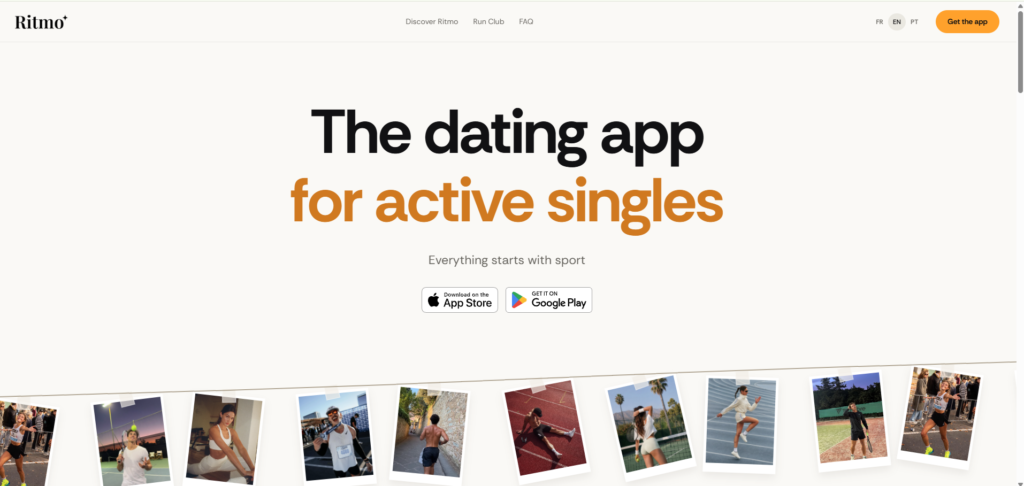
A shared interest can provide a way for strangers to communicate. They can meet each other because of a shared activity. Ritmo’s dating company is based on that link, attracting singles who desire sport and fitness to be a part of their dating.
It’s important to pay attention to the early numbers. At the time of this writing, TrustMRR shows $4,388 in MRR and 466 active subscriptions, verified via RevenueCat API connection. These are paying demand numbers, but don’t necessarily indicate ongoing profitability.
Ritmo Business Quick Overview
| Metric | Verified Data |
|---|---|
| Company | Ritmo (ritmodating.com) |
| Founder | Adel Benzehda (@adeluxui), based in Beaujeu, France (App Store) |
| Launch Date | September 2026 (Google Play) |
| Monthly Recurring Revenue | $3,871 RevenueCat-verified MRR |
| Trailing 30-Day Revenue | $3,587 (+2,237% vs. prior period); $3,740 all-time revenue |
| Active Paid Subscriptions | 401 active subscriptions |
| User Traction | 7,000 users, 400,000+ swipes, and a 4.5/5 rating across 99 iOS reviews |
| Team & Funding | One person, bootstrapped |
| Recognition | 3rd Place, HAMM Award at RevenueCat Shipaton 2026 (RevenueCat) |
The Dating Problem Hiding in Fitness Communities
When one’s life is centered around training, compatibility also has to do with practical issues:
- Does a potential partner enjoy being active?
- Do they fit into their routines?
- Would they prefer to run together, rather than texting again?
Ritmo has a message for people who find someone attractive, but don’t know what to do together.
The founder, Adel Benzehda, says he has heard a question asked at run clubs repeatedly: “Who was single?” Romantic availability was still to be determined, but people shared an activity. The observation was the first step in the development of the app.
The business opportunity sits inside an existing social habit. Ritmo doesn’t have to convince people to think that exercise can be social. The problem is convincing enough like-minded singles in the same vicinity to sign up for the service.
That distinction matters. A dating service might have thousands of users registered and still fall short for someone who doesn’t get a lot of people that are relevant to them.
Product Breakdown: How Ritmo Connects Sports and Dating?
Ritmo’s profiles consist of sports, training habits, personal bests, completed races and interests. Members can like profiles, match when they are interested and chat. The app also recommends activities to do on a date, based on shared interests.
This information provides a starting point for discussions. A person training for a race has more to say than a picture might indicate to another runner.
There are also local Run Clubs included in the product. Members can register for runs, participate in club conversations and discover the profiles of participants after the run. Local organisers lead these groups, and applications to open clubs undergo review.
In a business sense, it’s a potential scenario: Users come to an event through the app, then they become more familiar with the event, and then they return to the app to reconnect with the event.
It is not yet proven that this cycle works for retention. But it provides Ritmo with a tangible link between digital and offline activity and results.
Founder Story: How a Non-Coder Built Ritmo in 6 Weeks?
Benzehda is a product designer with no prior experience in mobile or web apps before Ritmo. The published timeline says that the idea will be available on August 24, 2026, Google Play will be available on September 4, and the App Store will be available on September 17. He worked on his own in the design, development, marketing and business operations.
This means that it takes about 11 days to get an idea released on Android.
The lesson to be learned is that a particular question heard in a community can become a clearly defined product.
The speed of the business is not the only criterion for determining if it will be a successful business. The solo-founder is also responsible for support, moderation, payment and releases. The more members, the more responsibilities that need to be fulfilled and less time to invest in product improvements.
Ritmo is thus an early example of what one person can start, but not of the amount of operational support the business will need.
Business Model: How Ritmo Generates $4K in Monthly Recurring Revenue?
Ritmo is a free-to-use, but also paid and individual, subscription-based application. It is listed in the Irish App Store with Ritmo Pro Monthly (€6.99), Ritmo Pro 6-month (€17.99), and purchases like boosts and super likes. These prices are also subject to promotional offers, so they should not be considered as a country or offer price.
The rationale for the commercial side is simple: free participation increases the number of potential matches, and paid participation will yield profits from those who want to use the other services.
The cumulative revenue on TrustMRR’s October 23rd record was $4,675, which was the same as the MRR recorded. These are all different measures. MRR is a monthly representation of the recurring subscription, while cumulative revenue represents the sales to date.
These reported MRR divided by the number of active subscriptions comes out to about $9.42 per subscription per month. This is a calculated average, not a published plan price.
The founder independently announced profitability and the average return on advertising of 1.2 times on October 1. This is a founder claim: If a platform does not make a profit after the costs of platform fees, refunds, infrastructure, and others, then advertising return alone will not generate a profit.
Market Opportunity: Why Fitness and Dating Are a Natural Match?
Evidence already exists that fitness is a forum for meeting.
The 2024 Strava trend report was based on activity on the platform and over 5,000 people were surveyed around the world. 58% of respondents said they met fitness friends and almost one in five Gen Z respondents said they’d dated someone they met through fitness.
Those findings support Ritmo’s premise. They don’t measure the demand for its subscriptions, nor do they determine the size of its reachable market.
Benzehda says that Ritmo started in Brazil through fitness communities and targeted Meta ads. In his October 9 update, he said he had 3,694 profiles, 722 matches, and 7,477 private messages.
These are good indicators of early activity. They don’t provide information on the number of members who were active, the distribution of participation, or the number of conversations that turned into dates.
For this business, it might be more important for the city to be involved than for the business to be a large national registration. For each new location, there should be sufficient members who are interested in the location.
Bigger Lesson: What Ritmo’s $4K MRR Reveals About Startup Growth?
Ritmo demonstrates the power of a small customer base in the product development process and also in customer acquisition.
Sports interests are related to profile fields, conversation topics, event formats and advertising messages. This provides a level of consistency to the business’s existence.
The next test for it is repeatable performance. Some of the helpful metrics to consider are first-week retention, time to meaningful conversation, event attendance, subscriber churn and acquisition cost per city.
Those measures might be used to help inform practical changes. Low conversion rates could indicate a low level of local engagement. A high cancellation after purchase rate may indicate a discrepancy between the paid benefits and expectations.
The bigger idea is that pre-sales are a sign of interest in paying. They start the inquiry into the viability of a business to continue to provide value.
Why We Picked This Startup?
Ritmo was chosen because it is a customer problem that is clearly recognized and there is commercial evidence available.
The audience is very targeted, so the proposition is easy for people to understand. It’s a public revenue report that provides readers with something more solid than a sales pitch. The offline aspect also poses an interesting business question: Does an organised dating service make dating more useful?
There is evidence for an early business with paying customers. Long-term retention and repeatable expansion is still open question.
Ritmo is an excellent case study for founders looking to create a live, actual example of how to transform an existing community habit into a paid product, and then determine if that product becomes a habit in people’s lives.