
Selltora is bootstrapped and started in March 2026 by its sole developer, Enes Çamlıca, under the name SELLNES LTD. It achieved 600 registered users, 30-32 paying users, $690 in MRR, and $2,166 in total Stripe-verified sales within 7 months of launch without spending any money on paid ads. If you look at its public numbers, you’ll see both the upsides and the growth challenges of a solo micro-SaaS.
Problem
Selltora is designed to address this disjointed process, especially for Etsy sellers. The idea is simple: There’s a need for small merchants to help them tie the dots between product decisions and the effort they must put in to drive sales.
It’s not enough to open an online store; you must also promote it. Sellers must determine what to make, be aware of what products are out there, develop appealing images, write search engine-friendly listings and sell their product to buyers. Each task needs to be performed and will take time to earn money.
The trouble is, the diagnosis is frequently missed. Different interventions are required for a shop with low traffic volume as compared to a shop with visitors who don’t buy. The growth guide created by Selltora has a difference between visibility, weak presentation and issues that are present in the product page. That distinction provides a practical application for its software: determining what is important to attend to first when selling.
The chance for a startup catering to this audience is to avoid the loss of effort. Having more listings is only beneficial if those listings are geared toward the actual demand and provide shoppers with “reasons to buy.
Product
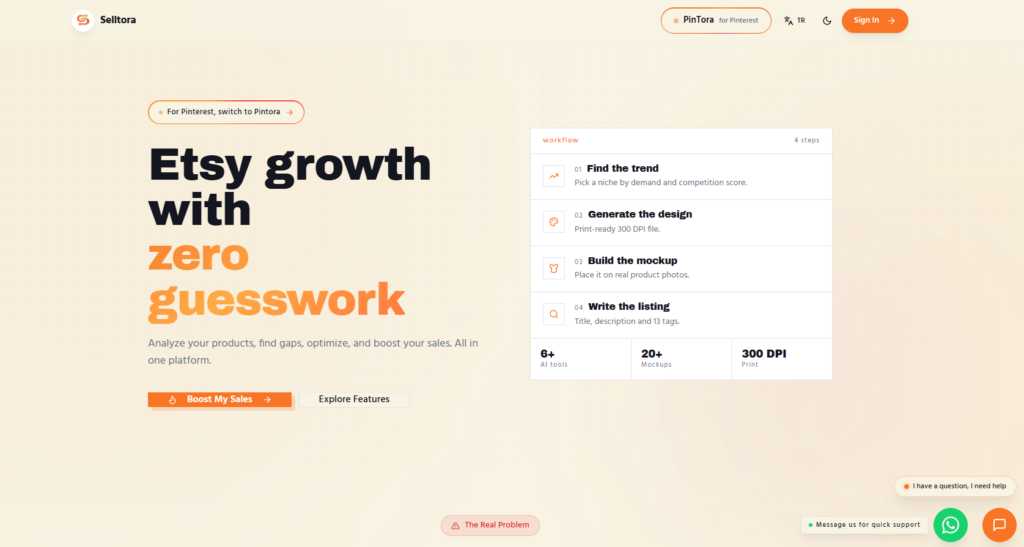
Selltora is a product analysis, review analysis, trend discovery, AI design generation, mockups and listing optimization tool all in one. It is claimed to have a workflow from niche to design, product image preparation and listing content writing.
The site offers print-ready designs at 300 DPI, over 20 mockups, and title, description and 13 tags for listings. These are advertised capabilities, rather than independently tested performance results.
It has also added its Pinterest offering, Pintora, to the workflow, making it easier to acquire traffic. Sellers can provide an Etsy product link or image to create Pinterest content. The product page claims that it offers 30 pin sets, copy that can be optimised for search engines, and automatic publishing.
The strategic appeal is continuity. Research can be used to help develop the product, the product can help develop the listing and the listing can provide material for product promotion. Combined, these steps will help to reduce repetitive handoffs for customers.
But having a lot of content doesn’t equal effectiveness. The real question is, do sellers save time and at the same time enhance qualified traffic, conversions, or profit?
Founder Story
Instead of bringing on an engineering team or raising venture capital, Enes Çamlıca wrote the entire 60,279-line codebase by himself, leveraging only React, Tailwind CSS, TypeScript, Supabase, Vercel, and Stripe. During a 12-month construction period, he contributed 2350 commits, or almost 6.5 commits each day.
He leveraged two different seller communities from day one because Çamlıca has developed the platform with complete bilingual support in Turkish and English. He has a number of early customers like Turkish Etsy shops that are selling to Western customers, and English-speaking print-on-demand store owners. He also wrote about tactics on the company blog, such as a turnaround plan for Etsy stores in Turkish that covered the next 90 days, and an English guide to growing your Etsy store.
Despite quick product delivery, there was a distinct lack of a good operational model in the solo founder model. It’s been a completely video-first strategy of making short-form videos, with the founder leading the way, which means revenue has been on a roller coaster ride when there is a slowdown in content creation. In October 2026, Çamlıca used TrustMRR’s marketplace to sell Selltora for $15,000, having generated $2,166 in lifetime verified revenue, so he can focus on his new venture.
Business Model
Selltora has subscription fees and allows for usage limits. The plans it offers are monthly ones, and they cost $19, $49, and $99, respectively, for 100, 500 and 1,500 credits.
Pintora’s product page lists separate monthly tiers: $14.99 for 30 pins, $29.99 for 120 pins, and $59.99 for 300 pins.
The most apparent one is from TrustMRR. According to its update on 20th October 2026, its MRR is $611, its active subscriptions are 28, and its all-time revenue is $2,206 (verified by Stripe). These numbers don’t mean that they’re profitable or that they’ve achieved product-market fit, just that they’ve monetized early.
A possible solution that allows to link subscription revenues with usage costs is to set a credit limit. But for a correct evaluation of the model, it would be necessary to have data on customer retention, acquisition cost, workload of the support, and refunds.
Economics are also important to customers. For example, if a seller makes a profit of $10 on each extra order, he or she will need about five extra orders to make up for a $49 subscription. While this could save time, it’s important to have revenue promises that tie back to measurable results.
Market
There’s a large customer base on Etsy. As of the end of the year, it had 5.6 million sellers, 86.5 million buyers and over 100 million items listed for sale. In 2025, the gross merchandise sales of the Etsy marketplace amounted to around USD 10.46 billion.
Those numbers tell you what opportunities there are and the challenge. There’s a lot of competition in the catalog, and finding and showing the right product to the right people is crucial.
They are not to be confused with Selltora’s addressable market. There are a lot of sellers that may not be able to invest a lot of money, be very active or have workflows that don’t need AI-generated designs. A viable market estimate would exclude those merchants who have not had repeat orders or because they have not shown a willingness to pay, would be eliminated.
The seller’s current process can be included in the competition as well. A merchant might combine manual research, design software, general AI assistance, and scheduling tools. Selltora needs to have an integrated workflow that is both useful and worth another subscription.
A targeted customer base might be more important than being able to claim to cater to all online retailers.
Bigger Lesson
Selltora is an example of a practical startup thesis, which is to package up a set of tasks that are related to a familiar customer problem.
The advantage of this method is that it’s easy. The one thing that it lacks is width. Each extra service generates expectations with regard to quality, reliability, and support. A product can have a great selection of items, but leave customers scratching their heads and not knowing where to start.
One good next step would be to have an onboarding that is based on outcomes: get one specific seller to do one valuable thing and see what happens.
For instance, a controlled pilot can track the time spent on listing preparation, consistency published, qualified visits and orders generated. Pre- and post-comparisons of those measures would provide more compelling evidence than single statements.
If there were to be retention, then it would be another test. If customers keep paying after they have tried it, they are sending a different message than the customers who are drawn to a launch offer.
The moral for founders is to make the value of the product visible.
Why We Picked This Startup?
We chose Selltora because it’s at an early stage; the business mechanics are obvious: a particular audience, regular tasks, subscription pricing, and there’s a public record of paying customers.
It provides a helpful example to consider when assessing a very specific software opportunity. The main issue is whether they believe that they are adding value in integrating daily work or do they require additional payments to do so?
The evidence available suggests that it is commercially viable to validate in the early stages. More proof would indicate lasting retention, customer results, and an operation that is not dependent on the founder’s acquisition.
It is that unfinished journey which makes Selltora worthwhile to study.